
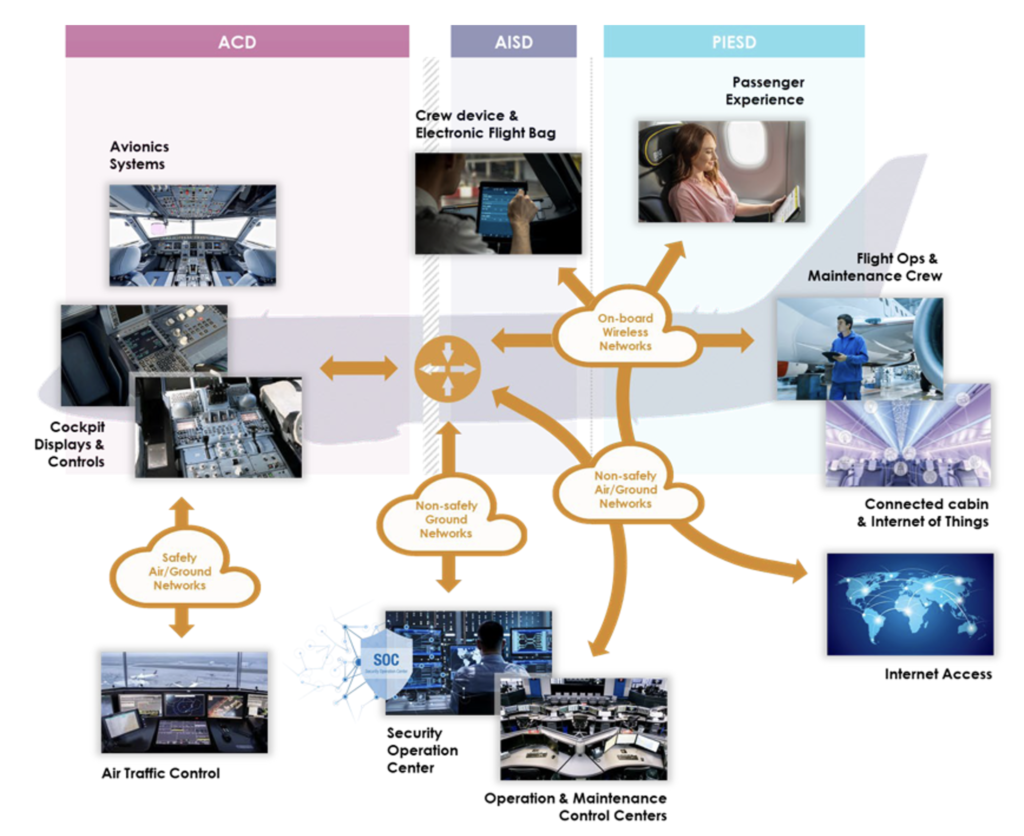
Connected aircraft have existed for decades, but higher-availability broadband connectivity is creating new opportunities to support non-passenger operational applications, airline efficiency, and cockpit/flight operations workflows.
ACARS entered service in 1978. Inmarsat Aero Satcom entered service on the Boeing 747-400, bringing forth the first truly “connected airplane” with service to flight crew, flight managements, airplane health monitoring, aircraft maintenance, and for cabin applications.
Inflight connectivity (IFC) entered the marketplace in 2000 and has grown massively since then, but until now has largely been constrained to passenger services with limited support for electronic flight bag (EFB).
The market is at an inflection point, driving a broader set of operational applications if reliability, availability, redundancy, and cybersecurity requirements are addressed.
Mature IFC Connectivity
IFC is becoming more available and capable, creating new options for operational applications. It is conceivable that availability levels above 99% are forthcoming, which supports discussion of “ubiquitous” connectivity as an operational enabler.
Operational Efficiency
Airlines are interested in connectivity that can improve operational efficiency, including fuel optimization, trajectory optimization, routing, weather updates, and faster operational turnaround. These objectives have been realized progressively since 1990. IFC brings much lower cost and much higher performance that what has been possible which opens the door to a new cascade of applications.
Secure Operational Data Exchange
Operational use of cabin or public connectivity systems requires secure transport, authentication, and protection against corrupted or unauthorized data. These are manageable using existing network protocols and architectures.
Multi-Domain Aircraft Architecture
The use of IFC for airline operations requires communication across aircraft domains, including cockpit, cabin, aircraft operational, and ground domains. This raises cybersecurity, certification, and architectural questions. These are manageable using existing network protocols and architectures.
Redundancy and Availability
A growing dependency on broadband links drives the need to consider redundancy, including the possibility of dual, independent satellite systems or “fail op” concepts for resilience.
Seamless Air Alliance Work Program
Prioritize airline use cases by operational value
Rank use cases according to airline pain points, business value, safety relevance, implementation complexity, and dependency on broadband availability.
Separate passenger connectivity from operational connectivity
Distinguish passenger connectivity from non-passenger connectivity (airplane health monitoring, administrative communication, operational communication, air traffic service) to avoid confusion over users, requirements, and architecture.
Focus on secure end-to-end architecture
Define how aircraft systems and connectivity providers interact securely across domains.
Address communication cost as a core barrier
Because communication cost was identified as a major pain point, evaluate commercial models, cost-per-message concerns, and cost-per-flight-hour concerns.
Develop a roadmap for redundancy and availability
Operational dependency on broadband connectivity affects requirements for redundancy, fallback, and service continuity.
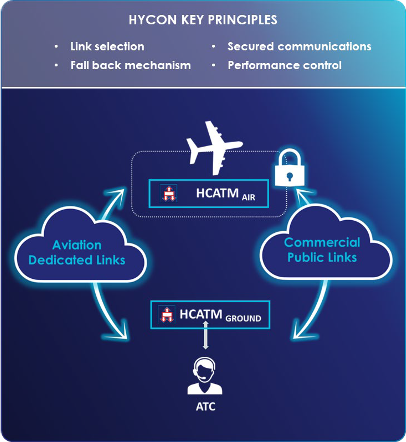
HYCON is a framework that can support the transport of safety and non-safety data using IFC provided the required performance, security, and fallback communication capabilities are available.
Redundant, independent IFC networks can provide continued functionality through any single point of failure. A “fail op” IFC installation can provide an equivalent service as any single existing safety radio service requires regulatory acceptance, alongside demonstrated communication performance.
Seamless Air Alliance has developed two surveys to gather marketplace insights regarding use of IFC for non-passenger communication.
SURVEY 1
TECHNICAL TRACK
For: Flight Crew | Maintenance Technicians | Avionics & IT Engineers | MRO Staff
~15 minutes
This is the longer of the two surveys. Because the technical realities of aircraft connectivity are complex and varied, we have included a broader set of questions covering onboard data links, ground connectivity, system reliability, maintenance workflows, and hardware lifecycle. We know your time is valuable but so is your experience, and no one else can speak to these topics the way you can.
To our flight crew members: your perspective on cockpit connectivity tools, from ACARS to EFB data services is something only you can provide. Please take a few minutes to share it.
To our maintenance and MRO colleagues: you see what operators and suppliers often miss. Your insight on ground-upload windows, fault diagnostics, and hardware supportability is critical to this survey.
Online Survey 1
Download Survey 1
Please email completed downloaded surveys to cxsurvey @ seamlessalliance.com
SURVEY 2
MANAGEMENT AND DECISION-MAKER TRACK
For: Fleet Managers | Operations Directors | CIOs | Procurement & Strategy Leaders ~5–7 minutes
This is the shorter track. It is a focused set of strategic questions on investment priorities, regulatory landscape, vendor ecosystem, and the ROI of connectivity programs. Designed to be completed in a single sitting, even on a tight schedule.
Online Survey 2
Download Survey 2
Please email completed downloaded surveys to cxsurvey @ seamlessalliance.com
